Twinkl Robotics.
An educational robotics game created to teach UK schoolchildren how Mars rovers are designed, programmed, and tested through hands-on construction, autonomous navigation, and sample collection challenges.
Context
Twinkl Robotics was developed at Twinkl Educational Publishing in collaboration with UK-RAS, the UK Robotics and Autonomous Systems network, as part of an initiative to introduce schoolchildren to robotics, engineering, and space exploration.
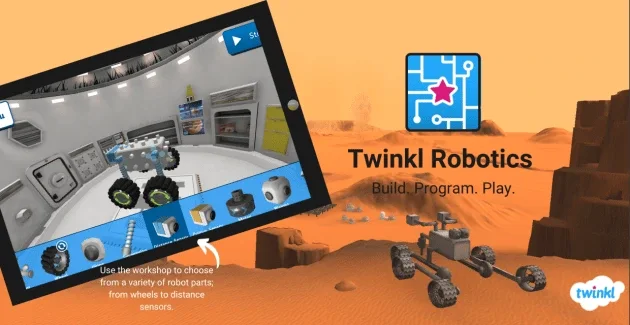
The game allowed players to design and build their own Mars rover using a modular construction system inspired by physical robotics kits and games such as Kerbal Space Program. Players could attach different components to a central rover body, including wheels, sensors, drills, stabilisers, counterbalances, and experimental movement parts.
Once built, the rover could be sent onto Mars-style terrain where players tested whether their design could navigate obstacles, follow paths, collect samples, and complete level objectives.
A key feature of the game was its autonomous programming system. Players could attach a camera sensor to the rover and program it to detect and follow black line paths across the terrain. This introduced children to real robotics concepts such as sensors, navigation logic, automation, environmental detection, and task-based programming.
The project was designed not only as a classroom learning tool, but also as part of a robotics competition for UK schoolchildren. Competition levels were created for live events held in partnership with UK-RAS, giving children the opportunity to test their rover designs against structured challenges.
My Role
Game design, level design, environment design, lighting, particle effects, gameplay support, bug fixing, and competition level creation.
What I Built
- Level design for the main educational progression across multiple challenge categories
- Mars-style environments designed around rover navigation, obstacle avoidance, and sample collection
- Tiered difficulty structure for navigation, line-following, drilling, and autonomous rover challenges
- Competition levels used for UK school robotics events in 2019 and 2020
- Terrain layouts involving flat ground, hills, rocks, slopes, paths, and sample collection objectives
- Gameplay scenarios designed to teach children how rover design affects movement and stability
- Lighting and environment presentation for Mars-themed level scenes
- Particle effects and visual polish for interactive gameplay feedback
- Post-release bug fixing and project maintenance after the main development phase
- Ongoing support for new competition content after other team members had moved onto other projects
- Cross-platform support for iPad, iPhone, Android, and PC releases
Outcome
Twinkl Robotics helped introduce schoolchildren across the UK to robotics, engineering, programming, and space exploration through an interactive game-based learning experience.
The project was used as both an educational classroom tool and as part of real-world robotics competitions held in partnership with UK-RAS. Children were able to design rovers, test them in simulated Mars environments, and learn how different components affected navigation, stability, automation, and task completion.
My work on Twinkl Robotics built directly on the experience I gained from Little Red Coding Club, particularly around designing educational gameplay that teaches technical concepts through interaction rather than passive instruction.
The project also became one of my earliest examples of long-term product support. After the initial release, I continued maintaining the game, fixing issues, and creating new competition levels for the 2019 and 2020 events, helping keep the product active beyond its original development cycle.